When I was a kid growing up in Santa Cruz, California, my friends and I often dined at Taqueria Vallarta, where our meager budgets would buy a huge burrito or plate of nachos, a giant glass of horchata, and limitless chips & salsa.
The salsa bar at Taqueria Vallarta offered a delicious array of tomato, pepper and tomatillo based options, but what has stuck in my memory best over the years has been the delicious pickled carrots & jalapeños, which I would pile on top of whatever my main dish was.
I rarely saw these pickled veggies at other establishments, and never executed with quite the excellence that I had come to expect. I thought they must be a rare, geographically local tradition. Perhaps the recipe originated from Vallarta, namesake of my beloved taqueria?
Recently I decided to unravel the mystery. Like most things in life, the obscure becomes common when you learn the right name to google on. Jalapeños en escabeche (pickled jalapeños) are not the sacred, secret food I had come to believe they were. In fact, you can buy them canned in any supermarket that offers even a modest Hispanic foods section. Having learned this, I bought and tried some of the mass-produced version, but of course they didn't live up to my hopes.
I decided I should try to make them myself. Having a name for these tasty goodies made it pretty easy to find recipes on the web. That should make it pretty easy, right? Unfortunately, none of the recipes can gloss over the fact that pickling is a careful process that requires sterile preparation and a technique for food preservation, called canning, that pressure-seals food inside glass jars.
Sigh. This is getting complicated. I've never canned. I don't own any canning equipment. There's a good chance I would fail at this task, but the allure of those tasty memories drives me onward.
For a few dollars at your local hardware or kitchen supply store, you will come home with a set of jars and lids, perfectly suited to the task of home canning. I bought the equipment, and set out to tackle this recipe.

The first thing you need is a big pot of boiling water. The main trick in canning is to take a hot (and sterile) jar, put hot food inside of it, put the lid on, and wait for it to cool. As part of the cooling process the contents suction the lid ever tighter against the lip of the jar, forming a seal where a rubbery coating touches the jar. They make special equipment for heating and preparing food in this way, but I wasn't prepared to invest too much in this whim.

For the veggies, you cut them up in whatever size you want, sautee them, and simmer them in vinegar to get that good pickling flavor to permeate through the vegetable. After a few minutes they start to lose their fresh crispness. I probably cooked mine a little too long, as the final result was a bit mushier than I would prefer. You can guess by the amount of color they have lost that they are a bit overdone.

I used tongs to transfer the contents into jars and pack them as well as I could. Then I spooned the vinegar liquid over the vegetables to just a bit under the lip of the jar. After the jars are filled, I wanted to be sure the contents were still hot and any residual germs were killed, so I placed the filled jars into the simmering water for several minutes (further overcooking the veggies, I'm sure).
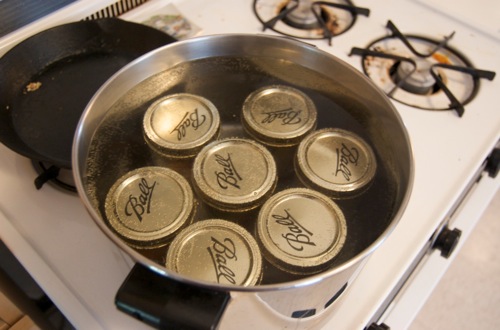
I removed the jars and placed them on the kitchen table to cool. At this point, the lids are screwed on just enough to hold the metal discs in place. It's the metal disc itself that will suction to the jar and provide the lasting seal. You know how bottles juices have the depressed lid that will "pop" when you open it? That's the same story here, the lid centers depress so you can tell they're sealed.

You can see that I used an assortment of peppers in addition to the jalapeños. It added a nice variety to the palette of colors, and I figured if I was going to experiment, I might as well, ahem, pack as much into this project as possible.
So how did it turn out? The veggies are delicious, but perhaps a little oilier and mushier than I would have liked. Also, it turns out that even though the recipe is for pickled jalapeños, it's the carrots that I coveted most. One of the unusual things Taqueria Vallarta did was to include very large chunks of carrot so there was plenty to go around. When I make these again, I'll use very hot peppers and fewer of them, to make room for more carrots as receptacles for the delicious spicy pepperiness.
It turns out I was able to can my own food at home. Nothing exploded and nobody died. It opened my eyes to a world of possible pickling and canning projects that can produce delicious results that can be stored for months in the pantry. I won't say it was a cakewalk ... it was nervewracking and seemed fraught with peril, but I am sure it gets easier with practice.